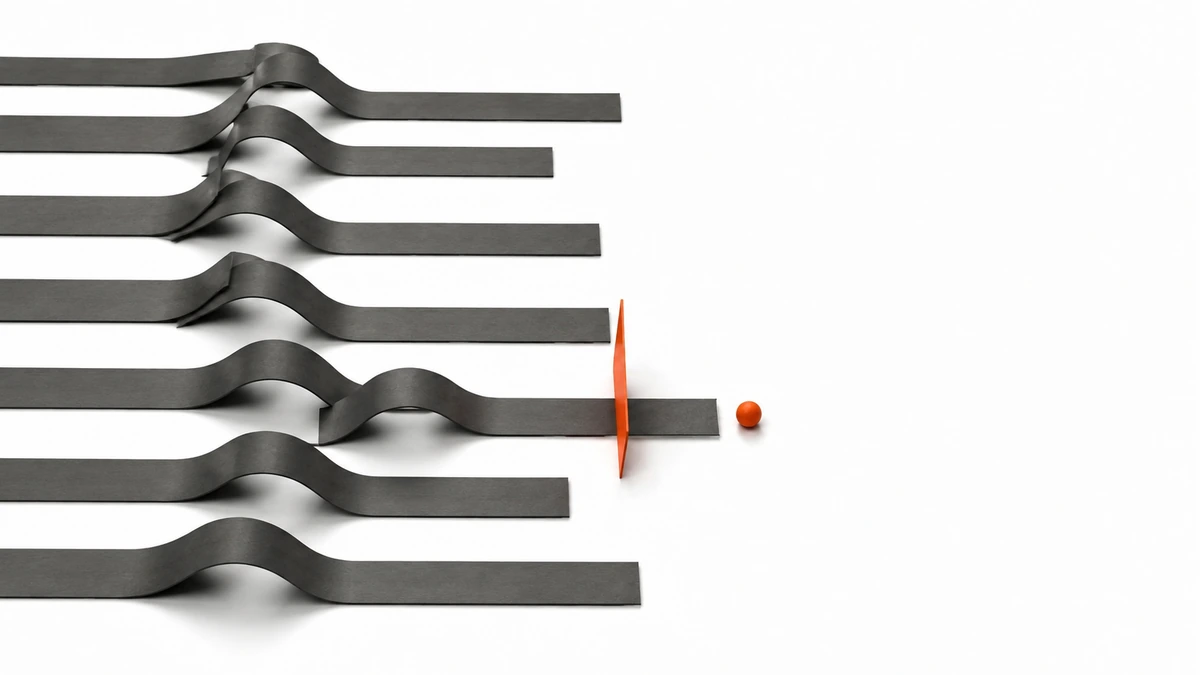
Show a person, or a system, the number they will be judged by, and you have already shaped what they will do. Not influenced. Shaped. A metric is never a neutral observer of the work; it quietly becomes the work. This is the oldest trap in management, and every system that learns walks straight into it.
The principle has a name, Goodhart's law: when a measure becomes a target, it stops being a good measure. A call centre rewarded for short calls will end calls. A model rewarded for engagement will learn to provoke. Nobody decided to optimise for the wrong thing. They simply measured the easy thing, and the easy thing took over.
The easy number and the true one
Almost always, the thing we care about is hard to measure and the thing next to it is easy. We care about whether a customer felt helped; we measure how fast the ticket closed. We care about whether a decision was sound; we measure how quickly it was made. The easy number is a stand-in, and we forget it is a stand-in the moment we start rewarding it.
The discipline is not to find a perfect metric, there isn't one, but to stay honest about the gap between what you can count and what you actually mean. A good measure is held loosely, revisited often, and never mistaken for the thing itself.
What you measure is a statement of what you value. Choose it carelessly and you will get exactly what you asked for, and not at all what you wanted.
How to choose a number you can live with
Before we let any system optimise for a metric, human or machine, we put the candidate number through three questions. They are not technical. They are about consequences.
- 01If this number went up and nothing else changed, would we actually be glad? If you can imagine it rising while the thing you care about falls, it is the wrong number.
- 02What would someone do to game it? Imagine the laziest path to a great score. If that path is harmless, good. If it is corrosive, you have found your blind spot before it finds you.
- 03What does it leave out? Every metric is silent about something. Name the silence, and keep a second number nearby to guard it.
This matters more, not less, as systems get better at optimisation. A tool that pursues a goal relentlessly is a gift when the goal is right and a hazard when it is slightly wrong, because it will chase the flaw with the same tireless precision it would have chased the truth. The intelligence of the optimiser does not protect you. Only the wisdom of the target does.
Choose the metric deliberately, test how it can be gamed and name what it leaves out before a person or system is asked to optimise for it.